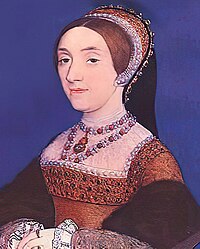
* This is about the sad life of Catherine Howard, who was a lot more like her cousin Anne, than many believed. Please excuse the length I just really like the subject of the wives of Henry VIII.
Catherine Howard's birth date is unknown, there is only one portrait believed to be of her, yet she was queen.She was born to Lord Edmund Howard and Joyce Culpeper. As a granddaughter of Thomas Howard, 2nd Duke of Norfolk, Catherine had an aristocratic pedigree, but her father, who was a younger son, was not well-off owing to primogeniture and the large size of his family. As a result, he was often reduced to begging for handouts from his more powerful relatives. In 1531, he was appointed Controller of Calais. He was dismissed from his post in 1539, and died in March of the same year. Catherine was also the niece of Elizabeth Howard, who was the mother of Anne Boleyn. This would make Anne and her first cousins, and later on so much more.
 |
| Catherine Howard |
Early in her life, the orphaned Catherine was sent to live with her step-grandmother, the Dowager Duchess of Norfolk. At her estate at Lambeth the Duchess had many children of less-fortunate noble under her command. While sending young children to be educated and trained in aristocratic households other than their own was common for centuries among European nobles, supervision at Lambeth was apparently lax. An apparent effect of this was on the deficiency of Catherine's education.
Her character has often been described as vivacious, beautiful, and buxom, but never scholarly or devout. The casual upbringing in the licentious atmosphere of the Duchess' household led Catherine's music teacher, Henry Mannox, to start a sexual relationship with her around 1536, when she was between the ages of eleven and sixteen. He later gave evidence in the inquiry against her. Mannox and Catherine both confessed during her adultery trial that they had engaged in sexual contact, but not intercourse. Catherine was even quoted as saying, "At the flattering and fair persuasions of Mannox, being but a young girl, I suffered him at sundry times to handle and touch the secret parts of my body which neither became me with honesty to permit nor him to require."
This adolescent affair came to an end in 1538, when Catherine was pursued by a secretary of the Dowager Duchess' household, Francis Dereham. They became lovers, addressing each other as "husband" and "wife". Dereham also entrusted Catherine with various wifely duties, such as keeping his money when he was away on business. Many of Catherine's roommates among the Dowager Duchess' maids of honour and attendants knew of the relationship, which apparently ended in 1539 when the Dowager Duchess caught wind of the matter. Despite this disapproval, Catherine and Dereham may have parted with intentions to marry upon his return from Ireland, agreeing to a precontract, as it was then known. If indeed they had exchanged vows of their intention to marry before having sexual intercourse, they would have been considered married in the eyes of the Church.
Catherine's uncle the Duke of Norfolk had found Catherine a place at Court as a lady-in-waiting to King Henry VIII's new bride, German princess, Anne of Cleaves. Being a young and beautiful lady-in-waiting to the king's wife, whom he never displayed interest in, Catherine soon caught the eye of the king.
The Howard's who were seeking to regain the position they had had when Anne Boleyn was queen, trained Catherine to make sure she became the king's new mistress and later wife. As the King's interest in Catherine grew, so did their influence. Within months of her arrival at Court, Henry bestowed gifts of land and expensive cloth upon Catherine.
When Henry had his marriage to Anne of Cleves annulled on 9 July 1540, rumours swirled that Catherine was pregnant with his child. Their quick marriage a mere three weeks after the annulment, reflected Henry's lifelong urgency to secure the Tudor succession by fathering healthy, legitimate sons, especially since he only had one, Edward. Henry, nearing fifty and expanding in girth, showered his young bride with wealth, jewels, and other expensive gifts. Catherine's motto, "Non autre volonté que la sienne", or, "No other will but his", supposedly reflected her desire to keep Henry, an ailing man three decades her senior, content. At this point in his life, the King weighed around300 pounds, and had a foul-smelling, festering ulcer on his thigh that had to be drained daily.
 |
| Possible Portrait of Catherine Howard |
Early in 1541, Catherine embarked upon a romance with Henry's favorite male courtier, Thomas Culpeper, a young man who, according to Dereham's testimony "had succeeded [him] in the Queen's affections", and who Catherine had considered marrying during her time as a maid-of-honour to Anne of Cleves. The couple's meetings were arranged by one of Catherine's older ladies-in-waiting, Lady Rochford, the widow of Catherine's cousin, George Boleyn, the brother of Anne Boleyn.
Catherine and Henry toured England together in the summer of 1541, and preparations for any signs of pregnancy, which would have led to a coronation, were in place, indicating that the royal couple were sexually active with each other. During this time, however, a crisis began to loom over Catherine. People who had witnessed her indiscretions at Lambeth began to contact her for favours in return for their silence, and many of them were appointed to her household. Most disastrously, Catherine appointed Francis Dereham as her personal secretary, at the urging of the Dowager Duchess of Norfolk. This miscalculation led to the charges of treason and adultery against her two years after her marriage to the King. Catherine Howard was sentenced to beheading at seven a.m. on February 13.
The night before her execution, Catherine is believed to have spent many hours practicing how to lay her head upon the block, which had been brought to her at her request. She died with relative composure, but looked pale and terrified and required assistance to climb the scaffold. She made a speech describing her punishment as "worthy and just" and asked for mercy for her family and prayers for her soul. According to popular folklore, her final words were, "I die a Queen, but I would rather have died the wife of Culpeper," although this is widely discredited. Catherine was beheaded with a single stroke, and her body was buried in an unmarked grave in the nearby chapel of St. Peter ad Vincula, where the bodies of her cousins, Anne and George Boleyn, also lay. Henry did not attend.