Showing posts with label Love. Show all posts

Sunday, October 7, 2012

The New World

    Upon my recent fascination of the nature of the relationship between John Smith and Pocahontasd I allowed myself to break down and watch the 2 hour plus movie, The New World. The movie is centered around a romantic relationship that involves handsome Captain John Smith and Powhatan Princess Pocahontas. What I discovered was although the story is not mainly told through dialog the viewer knows at all times what is going on. The love between the main characters is so sweet, natural, and lacking in any ulterior motives. It was just love.
    This a movie that people love or hate. It is filled with random shots of nature thrown in the middle of a scene. However, one has only to know the title of the movie to know the true star, The New World. Shot on location at Jamestown with actors of Native American descent to play the Powhatans, even speaking Algonquian, you feel as if what you are seeing is happening right then and there not on a film set. I was pleasantly surprised by this film. Even though John Smith and Pocahontas may not have been actually romantically involved I found myself wishing it so. I plan on doing an upcoming post that goes more in depth about their relationship.


Saturday, August 4, 2012

Changeling by Philippa Gregory

Isolde
     Changeling is the first young adult novel by critically acclaimed historical-fiction by Philippa Gregory. Changeling is set in 1453 when every unexplainable thing is seen as the coming of the end of the world. I think that the best way to describe this book without giving it all away is to just introduce the major characters:
Luca Vero

Luca Vero- Luca is a handsome and intelligent young monk in training who is sent to investigate the oddities occurring all over Europe after being arrested for heresy.
Freize- Kitchen boy at the monastery where Luca lived. He is Luca's friend and constant companion.
Isolde- Is the daughter of a wealthy lord raised to believe that she will inherit her father's lands and castles. However, on her father's death her inheritance is usurped by her brother who demands she a marry a man of his choice, or become a nun. There is a growing bond between Luca and Isolde (Gasp!)
Ishraq- Is Isolde's companion having been raised alongside her. Ishraq is a Moor and so is therefore Muslim, being brought back by Isolde's father from his travels.

Changeling is the first book to be released in an upcoming quartet.

Monday, May 28, 2012

Days of Splendor, Days of Sorrow

      Days of Splendor, Days of Sorrow by Juliet Grey is the sequel to Becoming Marie Antoinette. Days of Splendor, Days of Sorrow spans fifteen years in the tumultuous life of one of history's favorite villains, Queen Marie Antoinette. Marie Antoinette had a lot to deal with during her reign as queen from the stifling etiquette of Versailles to the rumour mill that was constantly running rampant by many so-called "friends".
      Juliet Grey does an exceptional job portraying the beautiful tableau's of Pre-Revolution France. Grey has put a great deal of research into this book as you can feel the tension, love, and sorrow as if you were there. One can just imagine the riveting trails and executions of The Diamond Necklace Affair. This book offers a look into the many different relationships Marie Antoinette had including with her husband King Louis XVI, her lover, Count Axel von Fersen, her friends, the Duchesse de Polignac and the Princesse de Lamballe. Marie Antoinette had a very loving relationship with her children the sorrow she felt at her miscarriages and during the death of two children are truly heart-wrenching.
        I would truly recommend this book because it's exceptional attention to detail and the unbelievably true story. Days of Splendor, Days of Sorrow is a very apt title for this novel starting with the splendor of a glorious coronation and ascension to the throne, but at the conclusion the sorrow of losing a child and the end of their lives as they knew it with the start of the Revolution. The conclusion to the Marie Antoinette series The Last October Sky will be out in 2013.

Tuesday, March 27, 2012

Juana la Loca

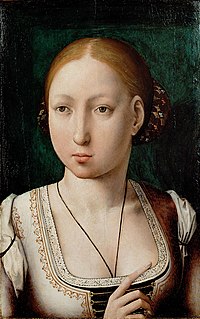
Juana, before the mad
I am so glad I live in a time of modern psychiatric medicine. All throughout royal family trees you see weird family members with weird epithets like "the bewitched", "the crazy", or in this case "the mad." Nowadays, a psychiatrist would just throw a handful of pills at them and who knows how different we would be now. The reason for all of this was to keep power in the family. A great way to do that? Inbreeding! The ancient Egyptians took goddess Isis and her brother/husband Osiris as prime examples. In Europe the relationship was not that close, but many times first cousins married without a word being said. Today inter-familial marriages would garner town names like Cousin-wood for example. Anyhow, mental instability was rampant in royal families. Here is the tale of just that Juana of Castile.   
       Born in 1479 to King Ferdinand of Aragon and Queen Isabella of Castile, Juana grew up expecting nothing more but to grow up and expand her parent's power and wealth. Her sedate childhood was no indication of the passionate person she would become. She was one of the most educated women of her tine speaking Castilian, Leonese. Galician-Portuguese, Catalan, French, and Latin; also, all accounts of her attest to her beauty. Juana was said to have had auburn hair and blue eyes, a trait she share with her sister-queen, Catherine of Aragon, future wife of King Henry VIII.
Phillip the "Handsome(?)"
       Unlike many other royal maidens at the time Juana lucked up. At the age of sixteen Juana was betrothed to Phillip the Handsome, Duke of Burgundy. Phillip was the son of the Holy Roman Emperor Maximilian I. The marriage of Phillip to Juana was to unite to lands so they could stand up to growing French power. Phillip's epithet must have been true, at first sight Juana fell madly in love with her husband to-be. The couple begged to married the night they met, both were so fond of each other. They started out in uncommon marital bliss.
      It's just to bad that Phillip didn't only have eyes for Juana. Phillip had many mistress' during his marriage to Juana, including one unfortunate lady-in-waiting who got a haircut straight from the duchess herself due to a little fling with the duke. Juana left the discarded the hair as a friendly reminder on Phillip's pillow. Despite the affairs Juana gave birth to five children in rapid succession. Juana also practiced witchcraft making love spells.
     Even after her marriage to Phillip, Juana kept loyalty to all things Spanish. Unfortunately Queen Isabella died and left Juana Queen of Castile. King Ferdinand did not like this, so he used Juana's mad behavior to try to grab Castile from her. Juana protested, she wanted to be queen. Then came the psychotic breakdown. Phillip died. Juana was pregnant with their sixth child at the time. She embraced the corpse as if it was still living. She accompanied it on the funeral procession, but insisted that they travel at night so no women would be tempted by him. Occasionally, she would even open the coffin and greet the dead body as if he still lived. 
The convent Juana was kept  at
for fifty years.
     Obviously, King Ferdinand milked this for all it was worth-after all countries were worth more than daughters. The king declared Juana insane and locked her inside a chamber in a convent in Tordesilles for the rest of her life.After her father died and her son came to rule he didn't have much mercy on his mother either. Juana died in 1555 at the age of seventy-five, she had been imprisoned for nearly fifty years.


Wednesday, March 14, 2012

The Queen of Misrule

* This is about the sad life of Catherine Howard, who was a lot more like her cousin Anne, than many believed. Please excuse the length I just really like the subject of the wives of Henry VIII.       
           
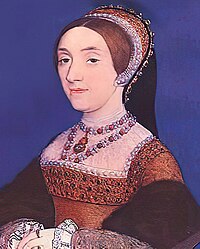
Catherine Howard's birth date is unknown, there is only one portrait believed to be of her, yet she was queen.She was born to Lord Edmund Howard and Joyce Culpeper. As a granddaughter of Thomas Howard, 2nd Duke of Norfolk, Catherine had an aristocratic pedigree, but her father, who was a younger son, was not well-off owing to primogeniture and the large size of his family. As a result, he was often reduced to begging for handouts from his more powerful relatives. In 1531, he was appointed Controller of Calais. He was dismissed from his post in 1539, and died in March of the same year. Catherine was also the niece of Elizabeth Howard, who was the mother of Anne Boleyn. This would make Anne and her first cousins, and later on so much more.
Catherine Howard
          Early in her life,  the orphaned Catherine was sent to live with her step-grandmother, the Dowager Duchess of Norfolk. At her estate at Lambeth the Duchess had many children of less-fortunate noble under her command. While sending young children to be educated and trained in aristocratic households other than their own was common for centuries among European nobles, supervision at Lambeth was apparently lax. An apparent effect of this was on the deficiency of Catherine's education.
          Her character has often been described as vivacious, beautiful, and buxom, but never scholarly or devout. The casual upbringing in the licentious atmosphere of the Duchess' household led Catherine's music teacher, Henry Mannox, to start a sexual relationship with her around 1536, when she was between the ages of eleven and sixteen. He later gave evidence in the inquiry against her. Mannox and Catherine both confessed during her adultery trial that they had engaged in sexual contact, but not intercourse. Catherine was even quoted as saying, "At the flattering and fair persuasions of Mannox, being but a young girl, I suffered him at sundry times to handle and touch the secret parts of my body which neither became me with honesty to permit nor him to require."
        This adolescent affair came to an end in 1538, when Catherine was pursued by a secretary of the Dowager Duchess' household, Francis Dereham. They became lovers, addressing each other as "husband" and "wife". Dereham also entrusted Catherine with various wifely duties, such as keeping his money when he was away on business. Many of Catherine's roommates among the Dowager Duchess' maids of honour and attendants knew of the relationship, which apparently ended in 1539 when the Dowager Duchess caught wind of the matter. Despite this disapproval, Catherine and Dereham may have parted with intentions to marry upon his return from Ireland, agreeing to a precontract, as it was then known. If indeed they had exchanged vows of their intention to marry before having sexual intercourse, they would have been considered married in the eyes of the Church.
         Catherine's uncle the Duke of Norfolk had found Catherine a place at Court as a lady-in-waiting to King Henry VIII's new bride, German princess, Anne of Cleaves. Being a young and beautiful lady-in-waiting to the king's wife, whom he never displayed interest in, Catherine soon caught the eye of the king.
          The Howard's who were seeking to regain the position they had had when Anne Boleyn was queen, trained Catherine to make sure she became the king's new mistress and later wife.       As the King's interest in Catherine grew, so did their influence. Within months of her arrival at Court, Henry bestowed gifts of land and expensive cloth upon Catherine.
         When Henry had his marriage to Anne of Cleves annulled on 9 July 1540, rumours swirled that Catherine was pregnant with his child. Their quick marriage a mere three weeks after the annulment, reflected Henry's lifelong urgency to secure the Tudor succession by fathering healthy, legitimate sons, especially since he only had one, Edward. Henry, nearing fifty and expanding in girth, showered his young bride with wealth, jewels, and other expensive gifts.  Catherine's motto, "Non autre volonté que la sienne", or, "No other will but his", supposedly reflected her desire to keep Henry, an ailing man three decades her senior, content. At this point in his life, the King weighed around300 pounds, and had a foul-smelling, festering ulcer on his thigh that had to be drained daily.
Possible Portrait of Catherine Howard
         Early in 1541, Catherine embarked upon a romance with Henry's favorite male courtier, Thomas Culpeper, a young man who, according to Dereham's testimony "had succeeded [him] in the Queen's affections", and who Catherine had considered marrying during her time as a maid-of-honour to Anne of Cleves. The couple's meetings were arranged by one of Catherine's older ladies-in-waiting, Lady Rochford, the widow of Catherine's cousin, George Boleyn, the brother of Anne Boleyn.
        Catherine and Henry toured England together in the summer of 1541, and preparations for any signs of pregnancy, which would have led to a coronation, were in place, indicating that the royal couple were sexually active with each other. During this time, however, a crisis began to loom over Catherine. People who had witnessed her indiscretions at Lambeth began to contact her for favours in return for their silence, and many of them were appointed to her household. Most disastrously, Catherine appointed Francis Dereham as her personal secretary, at the urging of the Dowager Duchess of Norfolk. This miscalculation led to the charges of treason and adultery against her two years after her marriage to the King. Catherine Howard was sentenced to beheading at seven a.m. on February 13.
        The night before her execution, Catherine is believed to have spent many hours practicing how to lay her head upon the block, which had been brought to her at her request. She died with relative composure, but looked pale and terrified and required assistance to climb the scaffold. She made a speech describing her punishment as "worthy and just" and asked for mercy for her family and prayers for her soul. According to popular folklore, her final words were, "I die a Queen, but I would rather have died the wife of Culpeper," although this is widely discredited. Catherine was beheaded with a single stroke, and her body was buried in an unmarked grave in the nearby chapel of St. Peter ad Vincula, where the bodies of her cousins, Anne and George Boleyn, also lay. Henry did not attend.

Sunday, November 27, 2011

Anne and William: Not Just "Second-Best"

   Their marriage was and still is filled with controversy. Was it a marriage of  love, or did it only deserve the "second-best bed."
Anne Hathaway

Anne Hathaway was born in the year 1556, in the small hamlet of Shottery about one mile from the town of Stratford. William Shakespeare was born around April 23, 1564 in Stratford. His father was John Shakespeare, a glove maker, and Mary, daughter of an affluent landowner. The age-difference between the two was an astonishing eight years! There are two ways people think of Anne Hathaway. One, as a 16th century cradle-snatcher and another as women who simply fell in love. Their wedding is also a very different from the norm at the time. Anne was expecting the couples first child at the time of the marriage. Maybe things would have been different if they had been betrothed, but they weren't. Anne was 26 at the time and William only 18, still considered a minor. The couple had to pay 40 pounds to buy a special bond so they could hurry up and be married.From the will of her late father it seems that Anne Hathaway brought a dowry to the marriage. Six months after they were married Anne gave birth to a daughter, Susanna. There is speculation that it was about this time that William might have offended Sir Richard Lucy by poaching a deer on his grounds. What with this, and what with the general misfortunes of the family, William left his young family and Stratford to seek his fortune in London. Acting troupes regularly visited the town of Stratford and this would have been a major form of entertainment. It is likely that William Shakespeare knew Will Kempe and possible that Shakespeare went to London with a troupe of actors when he left Stratford between 1585 and 1592. The rest, as they say, is history.Life continued for Anne with her children and in-laws in Henley Street. She never moved away from Stratford in the whole of her life. William, meanwhile in London, had started to become a success as a poet and was also making his name as an actor and playwright in the theatres of London. He occasionally returned home to see his wife and the family. He still kept an interest in the family businesses. 
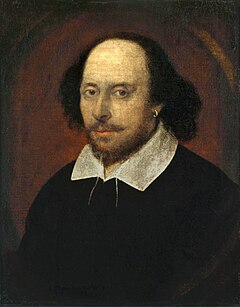
William Shakespeare
           By 1592 William was mixing with the elite of the literary and theatrical worlds. But the role of a playwright was still not viewed as a creditable occupation. It could, in fact , be a very dangerous one as plays could be used as vehicles for propaganda. The State understood the power of plays. Therefore, all plays that were to be printed had to be registered, which ensured a form of censorship. Shakespeare never published any of his plays during his lifetime.In 1596 the Shakespeare family continued to prosper. But the good fortune came to an untimely and abrupt end when, in August, their son Hamnet died at the age of just eleven years. There is no documentation which records the cause of Hamnet's death but it is highly likely that he died of the plague, which had wreaked so much devastation in London 6 months before. Hamnet was buried in Stratford. 
        In 1610, with his fortune made and his reputation as the leading English dramatist unchallenged, Shakespeare appears to have retired to Stratford.  Anne had her husband home at last. His business interests took him to back to London on occasion but the majority of his time is spent at home. He would have been able to enjoy life with his family including his daughters and granddaughter, Elizabeth.
          Shakespeare did, however, draft his will in January of 1616. Perhaps he was unwell. There are no records or documented evidence which throws any light as to the health of Shakespeare in 1616. The strain of the scandal surrounding Judith would not have helped. William’s son-in-law, Dr. John Hall, oversees his final days and treatment. And in April 1616 William Shakespeare dies. (The exact date or cause of death is unknown but it seems fitting that he died on April 23rd April, the same approximate date of his birth, on St. George's Day, the patron Saint of England). The funeral of William Shakespeare was on April 25th 1616  when he was buried in the chancel of Holy Trinity Church in Stratford. Anne, of course, would have been the chief mourner supported by the family of William Shakespeare.The only mention that Shakespeare specifically makes of his wife was to leave her his "second best bed." This is probably the most famous entry of any last will and testament. To bequeath such an item sounds totally ungenerous. It is, however, understood that it would have been Anne's right, through English Common Law, to one-third of William's estate as well as residence for life at New Place. So one of the most famous slap-on-the-face postmortem gifts, could actually not be that at all, and instead be a symbol of the love Anne and William Shakespeare shared.

LinkWithin

Related Posts Plugin for WordPress, Blogger...