Showing posts with label Shakespeare. Show all posts

Tuesday, August 20, 2013

The Real Richard III

Posthumously edited portrait of King Richard
  Wrongly portrayed as one of the nastiest villains on the English stage, King Richard III needs to be looked upon once more in brighter light. In Shakespeare's play he is depicted as a malformed tyrant, incapable of any humane act. While it is possible that Richard suffered from scoliosis, chances are it was not obvious under his clothes. In what is probably the most famous portrait of Richard, X-Ray has been used to show that Richard's humped back was added many years after his death. King Richard's remains were recently discovered under a parking lot in Leicester. His skeleton shows many postmortem wounds, which verifies many contemporary accounts. Richard's body was mutilated and abused after his defeat at Bosworth Field (which I will discuss more next post!)
   Born on October 2, 1452, Richard was the youngest of the Duke of York's sons. After his father's death, Richard and his brothers George and Edward, the future King Edward IV, were taken into the guardianship of Richard Neville, Earl of Warwick, who was often called 'the Kingmaker'. Richard's brother Edward had to fight to gain his throne, and Richard was always at his side. Richard was there through thick and thin. He fled with Edward to exile and returned to see him crowned King of England. 
  When Edward was crowned he rewarded his brother with the title of Duke of Gloucester. Along with the prestigious title Richard was given Anne Neville, daughter of his former guardian, the Earl of Warwick, in marriage. To the marriage Anne brought with her the extensive Neville estates located in northern England. 
  Now is when we see Richard's life become much more exciting. Upon the death of his brother the king, Richard was given guardianship of his nephew, the heir to the throne, and temporary control of the kingdom. Richard had agreed to rule until his nephew prince Edward could be crowned king. 
   And here is where Richard gets his shady reputation: On his way into London Richard had his young nephew thrown into the Tower of London. At first, Richard claimed it was for his safety, but only a short time later Richard declared the prince and his siblings illegitimate, making Richard, Duke of Gloucester, heir to the throne. His coronation took place the following month. 
Facial Reconstruction of King Richard
   However, Richard did not feel safe with only one of his nephews in the Tower. He also placed Edward's younger brother Prince Richard in the Tower, too. Soon after joining his brother in the Tower both boys disappeared. The boys were both presumed dead- murdered on Richard's orders. What we know now, however, is many people had the opportunity and the motive to kill the two boys. Sir Richard Brackenbury, the constable of the Tower, Henry Tudor, who needed the boys dead in order to seize the throne for himself, or even Henry Tudor's ambitious mother, Margaret Beaufort. Even after many excavations in the Tower of London no skeletons have been found that fit the boy's ages.

          Look Forward to my next article The Real Richard III Part Two:                                                           Bosworth and Beyond

Saturday, July 7, 2012

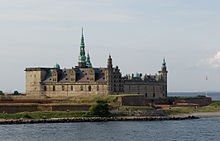
The Real Elsinore Castle

      Hamlet, Prince of Denmark is perhaps the greatest play in the English language. Set in Denmark, the play tells the story of revenge as Hamlet fights to avenge his father's murder. The setting for all of the action is Elsinore Castle.

But did you know Elsinore Castle really exists?

Kronborg Castle
Called Kronborg Castle in the town of Helsingor or Elsinore, Denmark the castle is one of the most important Renaissance castles of Northern Europe and is one of UNESCO World Heritage sites. Built in the 1420's by the Danish king, Eric of Pomerania, it was created as a fortress to collect dues on all boats that were passing through the sound that the fortress is located on.

From 1574 to 1585 King Frederick II had the fortress rebuilt into one of the most unique castles in all of Europe for it's surprising size and shape. King Frederick was a patron of the theater and players performed often when he held his court there in 1579.

In 1629 two momentarily reckless workmen accidentally caused the castle to go up in flames. All but the chapel was lost. King Christian IV put a great deal of effort into restoring the castle. The exterior was rebuilt without much change in design and was once again magnificent, yet the interior never regained it's former glory. During the Dano-Swedish War of 1658-1660 many of the castles most precious works of art were stolen during a Swedish occupation. 

Statue of Ogir has been placed
in the castle
This castle however interesting it's actual history may be will forever be remembered for it's fictional inhabitants and the tragic dual that took place there. Hamlet is performed at the castle often.

The castle is also home to an Arthurian legend. Ogir the Dane was taken by Morgan La Fay to Avalon. Ogir returned to save France from danger and later returned to Kronborg, where he sleeps until needed to save his homeland

Sunday, November 27, 2011

Anne and William: Not Just "Second-Best"

   Their marriage was and still is filled with controversy. Was it a marriage of  love, or did it only deserve the "second-best bed."
Anne Hathaway

Anne Hathaway was born in the year 1556, in the small hamlet of Shottery about one mile from the town of Stratford. William Shakespeare was born around April 23, 1564 in Stratford. His father was John Shakespeare, a glove maker, and Mary, daughter of an affluent landowner. The age-difference between the two was an astonishing eight years! There are two ways people think of Anne Hathaway. One, as a 16th century cradle-snatcher and another as women who simply fell in love. Their wedding is also a very different from the norm at the time. Anne was expecting the couples first child at the time of the marriage. Maybe things would have been different if they had been betrothed, but they weren't. Anne was 26 at the time and William only 18, still considered a minor. The couple had to pay 40 pounds to buy a special bond so they could hurry up and be married.From the will of her late father it seems that Anne Hathaway brought a dowry to the marriage. Six months after they were married Anne gave birth to a daughter, Susanna. There is speculation that it was about this time that William might have offended Sir Richard Lucy by poaching a deer on his grounds. What with this, and what with the general misfortunes of the family, William left his young family and Stratford to seek his fortune in London. Acting troupes regularly visited the town of Stratford and this would have been a major form of entertainment. It is likely that William Shakespeare knew Will Kempe and possible that Shakespeare went to London with a troupe of actors when he left Stratford between 1585 and 1592. The rest, as they say, is history.Life continued for Anne with her children and in-laws in Henley Street. She never moved away from Stratford in the whole of her life. William, meanwhile in London, had started to become a success as a poet and was also making his name as an actor and playwright in the theatres of London. He occasionally returned home to see his wife and the family. He still kept an interest in the family businesses. 
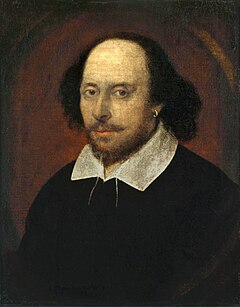
William Shakespeare
           By 1592 William was mixing with the elite of the literary and theatrical worlds. But the role of a playwright was still not viewed as a creditable occupation. It could, in fact , be a very dangerous one as plays could be used as vehicles for propaganda. The State understood the power of plays. Therefore, all plays that were to be printed had to be registered, which ensured a form of censorship. Shakespeare never published any of his plays during his lifetime.In 1596 the Shakespeare family continued to prosper. But the good fortune came to an untimely and abrupt end when, in August, their son Hamnet died at the age of just eleven years. There is no documentation which records the cause of Hamnet's death but it is highly likely that he died of the plague, which had wreaked so much devastation in London 6 months before. Hamnet was buried in Stratford. 
        In 1610, with his fortune made and his reputation as the leading English dramatist unchallenged, Shakespeare appears to have retired to Stratford.  Anne had her husband home at last. His business interests took him to back to London on occasion but the majority of his time is spent at home. He would have been able to enjoy life with his family including his daughters and granddaughter, Elizabeth.
          Shakespeare did, however, draft his will in January of 1616. Perhaps he was unwell. There are no records or documented evidence which throws any light as to the health of Shakespeare in 1616. The strain of the scandal surrounding Judith would not have helped. William’s son-in-law, Dr. John Hall, oversees his final days and treatment. And in April 1616 William Shakespeare dies. (The exact date or cause of death is unknown but it seems fitting that he died on April 23rd April, the same approximate date of his birth, on St. George's Day, the patron Saint of England). The funeral of William Shakespeare was on April 25th 1616  when he was buried in the chancel of Holy Trinity Church in Stratford. Anne, of course, would have been the chief mourner supported by the family of William Shakespeare.The only mention that Shakespeare specifically makes of his wife was to leave her his "second best bed." This is probably the most famous entry of any last will and testament. To bequeath such an item sounds totally ungenerous. It is, however, understood that it would have been Anne's right, through English Common Law, to one-third of William's estate as well as residence for life at New Place. So one of the most famous slap-on-the-face postmortem gifts, could actually not be that at all, and instead be a symbol of the love Anne and William Shakespeare shared.

Monday, September 26, 2011

O, Juliet by Robin Maxwell

    Everyone knows the story of the star-cross'd lovers from Verona. In this novelization the equally doomed lovers hail from Florence, are quite older, eighteen and twenty-five, and Dante Alighieri biggest 15th century fans. When Romeo Monticecco attends a Medici ball in order to gain a peace-making audience with the the city's patron, Cosimo de'Medici. At this ball Romeo meets Juliet Cappelleti, the daughter of the man his father hates. Juliet is the daughter of wealthy silk merchant, Capello Cappeletti. Capello wanting to further his wealth and prominence seeks a partnership with Jacopo Strozzi, whose family's wealth and power is second only to the Medici. In order to cement this partnership he offers his daughters hand in marriage to sweeten the deal. Jacopo, however, is no Prince Charming. He stinks, is cruel, and will do whatever it takes to get the handsome, verse-writing Romeo out of Juliet's head. There isn't a nurse in this retelling, but Lucrezia Tournabuoni de'Medici serves as Juliet's confidante and best friend.
      This retelling make the come to life in a new way. Shakespeare's version is still yet to be eclipsed , but this way way easier to understand. I hate to give any part of this book away to spoilers but the way Juliet's cousin, Marco, not Tybalt, gets murdered creates for far better drama. I would really recommend this book. But one thing that hasn't changed is there was never a tell of more woe than that of Juliet and her Romeo.

Tuesday, June 21, 2011

Montagues and Capulets: Fact or Fiction?

The opening lines of Shakespeare's Romeo and Juliet tell of two warring families, the Capulet's and Montague's, also telling the tragic out come of " two star-cross'd lovers" right from the start.


 Two households, both alike in dignity,
In fair Verona, where we lay our scene,
From ancient grudge break to new mutiny,
Where civil blood makes civil hands unclean.
From forth the fatal loins of these two foes
A pair of star-cross'd lovers take their life;
Whole misadventured piteous overthrows
Do with their death bury their parents' strife.
The fearful passage of their death-mark'd love,
And the continuance of their parents' rage,
Which, but their children's end, nought could remove,
Is now the two hours' traffic of our stage;
The which if you with patient ears attend,
What here shall miss, our toil shall strive to mend.
       
 .


But the question on my mind after reading this was who were these two families?


A HISTORICAL EXPLANATION


Shakespeare based his most popular tragedy, Romeo and Juliet, on two very real people. These young lovers lived in Verona, Italy ,just like his characters, and died in a real-life tragic love story in 1303. The Capulet and Montague families were prominent citizens of Verona at the time.Apparently, Shakespeare uncovered their story in literature. A poem, "The Tragical Historye of Romeus and Juliet," by Arthur Brooke, was written in 1562. William Painter, a prosist, penned "The Goodly History of the True and Constant Love of Rhomeo and Julietta. Matteo Bandello had written a novella of the story in 1554, revising Luigi da Porto's "Guiliette e Romeo" ("Juliet and Romeo"). Even earlier, Masuccio Salernitano had recounted the story of the tragic young lovers in "Mariotto and Gianozza of Siena" (which doesn't sound nearly as catch-y) in 1476.Italian traveling theater companies performed the drama throughout Europe and England. So, in all actuality Romeo and Juliet is not the original work of William Shakespeare but  just a tale retold from history.
Juliet's Balcony in Verona, Italy. Those are hundreds of love letters under it.

LinkWithin

Related Posts Plugin for WordPress, Blogger...