Showing posts with label literature. Show all posts

Tuesday, September 30, 2014

Hand of Fire by Judith Starkston

     I have been given the wonderful opportunity to review Judith Starkston's debut novel, Hand of Fire. This novel focuses on Briseis, a queen who is often no more than a footnote in the beautiful story of the Trojan War. I absolutely adore books that really flesh out otherwise minor characters since it is imperative for world-building. In Hand of Fire Briseis is given a beautifully woven back story. We see her spring to life as a young healing priestess who is taken captive by the Greeks.
     Leading the Greeks in their attacks is strong, handsome demi-god Achilles. Unlike many portrayals of Achilles in other works, Ms. Starkston's Achilles is well rounded and more complex. He is shown not as a mindless war machine, but as a young man who is aware of destiny and capable of being tender. Even after all the grief Achilles has caused for Briseis their relationship feels believable and real. 
      This story is so incredibly well researched, but not at all textbook-like that any reader, from the casual reader looking for a strong story to die hard history buffs, will find this book a pleasure. I really loved how this book made the ancient world come to life and be relatable to audiences while not losing its authenticity. It is evident Starkston felt such an attachment to her characters, because they are just so real! 
      All in all, I give this novel 4.5 out of 5 stars! If you are looking for an except of Hand of Fire, please click here, or if you are interested in purchasing it click here.
Judith Starkston


Find Q&A, book reviews, ancient recipes, historical background as well as on-going information about the historical fiction community on Starkston’s website www.JudithStarkston.com
Follow Judith Starkston on FB and Twitter   


Saturday, July 5, 2014

Real Life Game of Thrones


   The number-one reason I am loving George R.R. Martin's fantasy epic, A Song of Ice and Fire book series, is the hardcore political action. The second reason, is all the similarities between the fictional characters and real-life historical figures. The third reason, Jon Snow.

I mean c'mon...
But back to reason number two...

Martin's book series is the inspiration behind HBO's hit television show, Game of Thrones. The series is set in the land of Westeros, or the Seven Kingdoms. Martin has said he used The Wars of the Roses, which was a series of wars fought in England in the 15th century between warring families the York's and the Lancaster's. One of the most obvious relationships between the fictional and the factional are the names: two of the major families in Westeros are the Stark's and the Lannister's. However, more in depth, individual characters seem to be very similar to historical figures.


  • Robert Baratheon, king of the Seven Kingdoms seems to have a lot in common with the infamous King Henry VIII. Both kings were very athletic in their youth but as they aged declined into obesity and drunkenness. Kings Henry and Robert also both left the governing of their kingdoms to others.
  • Cersei Lannister, queen of the Seven Kingdoms and wife to Robert Baratheon. To me, Cersei is a character who seems to be based on pseudo-history. Cersei shares traits with the much maligned Queen Anne Boleyn. Anne Boleyn was accused of high treason and incest with her brother, much like the character, Cersei. However, Cersei was guilty... and there is still tons of debate over Anne's innocence.
  • Robb Stark, is the son of Eddard Stark, best friend to Robert Baratheon. In the chaos after the death of King Robert, Robb declares himself King in the North and fights many battles trying to win governance over Westeros. He gets so caught up in battle victory and love that marries a girl of little wealth and of little political gain. Much like King Edward VI. King Edward was a young King who fought hard to declare his place on the throne, but jeopardized the whole thing by marrying Elizabeth Woodville.
  • Daenerys Targaryen- The Targaryen family ruled Westeros long before Robert Baratheon fought his way to the Iron Throne. Daenerys is the only heir to the Targaryen family. Like the future King Henry VII, Daenerys was raised in exile, where she is plotting to regain her family's throne.
The Wall which stands to separate the known world from the wilderness is very similar to Hadrian's Wall. Hadrian's wall was built along the borders of the Roman Empire to keep out any outsiders. Imagine who scary a wall such as that would be.

Anybody see any different similarities to characters? And would like to see more Game of Thrones/ historical figures or events articles? I am very open to suggestions!


Saturday, August 4, 2012

Changeling by Philippa Gregory

Isolde
     Changeling is the first young adult novel by critically acclaimed historical-fiction by Philippa Gregory. Changeling is set in 1453 when every unexplainable thing is seen as the coming of the end of the world. I think that the best way to describe this book without giving it all away is to just introduce the major characters:
Luca Vero

Luca Vero- Luca is a handsome and intelligent young monk in training who is sent to investigate the oddities occurring all over Europe after being arrested for heresy.
Freize- Kitchen boy at the monastery where Luca lived. He is Luca's friend and constant companion.
Isolde- Is the daughter of a wealthy lord raised to believe that she will inherit her father's lands and castles. However, on her father's death her inheritance is usurped by her brother who demands she a marry a man of his choice, or become a nun. There is a growing bond between Luca and Isolde (Gasp!)
Ishraq- Is Isolde's companion having been raised alongside her. Ishraq is a Moor and so is therefore Muslim, being brought back by Isolde's father from his travels.

Changeling is the first book to be released in an upcoming quartet.

Saturday, July 7, 2012

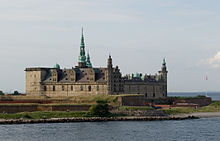
The Real Elsinore Castle

      Hamlet, Prince of Denmark is perhaps the greatest play in the English language. Set in Denmark, the play tells the story of revenge as Hamlet fights to avenge his father's murder. The setting for all of the action is Elsinore Castle.

But did you know Elsinore Castle really exists?

Kronborg Castle
Called Kronborg Castle in the town of Helsingor or Elsinore, Denmark the castle is one of the most important Renaissance castles of Northern Europe and is one of UNESCO World Heritage sites. Built in the 1420's by the Danish king, Eric of Pomerania, it was created as a fortress to collect dues on all boats that were passing through the sound that the fortress is located on.

From 1574 to 1585 King Frederick II had the fortress rebuilt into one of the most unique castles in all of Europe for it's surprising size and shape. King Frederick was a patron of the theater and players performed often when he held his court there in 1579.

In 1629 two momentarily reckless workmen accidentally caused the castle to go up in flames. All but the chapel was lost. King Christian IV put a great deal of effort into restoring the castle. The exterior was rebuilt without much change in design and was once again magnificent, yet the interior never regained it's former glory. During the Dano-Swedish War of 1658-1660 many of the castles most precious works of art were stolen during a Swedish occupation. 

Statue of Ogir has been placed
in the castle
This castle however interesting it's actual history may be will forever be remembered for it's fictional inhabitants and the tragic dual that took place there. Hamlet is performed at the castle often.

The castle is also home to an Arthurian legend. Ogir the Dane was taken by Morgan La Fay to Avalon. Ogir returned to save France from danger and later returned to Kronborg, where he sleeps until needed to save his homeland

Friday, February 17, 2012

Peasant, Hero, Heretic, Saint: Part II

            She arrived at the siege of Orléans on 29 April 1429, but Jean d'Orléans, the acting head of the Orléans ducal family, initially excluded her from war councils and failed to inform her when the army engaged the enemy. This did not prevent her from being present at most councils and battles. The extent of her actual military leadership is a subject of historical debate. Traditional historians conclude that she was a standard bearer whose primary effect was on morale. This type of analysis usually relies on the condemnation trial testimony, where she stated that she preferred her standard to her sword. Recent scholarship that focuses on the nullification trial testimony asserts that the army's commanders esteemed her as a skilled tactician and a successful strategist. Stephen W. Richey's opinion is one example: "She proceeded to lead the army in an astounding series of victories that reversed the tide of the war." In either case, historians agree that the army enjoyed remarkable success during her brief career.
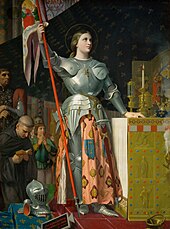
Joan of Arc
ca 1854
       Joan of Arc rejected the cautious strategy that characterized French leadership during previous campaigns. During the five months of siege before her arrival, the defenders of Orléans attempted only one aggressive move and that ended in disaster. On 4 May the French attacked and captured the outlying fortress of Saint Loup, which she followed on 5 May with a march to a second fortress called Saint Jean le Blanc, which was found deserted. The next day she opposed Jean d'Orleans at a war council where she demanded another assault on the enemy. D'Orleans ordered the city gates locked to prevent another battle, but she summoned the townsmen and common soldiers and forced the mayor to unlock a gate. With the aid of only one captain she rode out and captured the fortress of Saint Augustins. That evening she learned she had been excluded from a war council where the leaders had decided to wait for reinforcements before acting again. Disregarding this decision, she insisted on attacking the main English stronghold called "les Tourelles" on 7 May.
             The sudden victory at Orléans led to many proposals for further offensive action. The English expected an attempt to recapture Paris or an attack on Normandy. In the aftermath of the unexpected victory, Joan persuaded Charles VII to grant her co-command of the army with Duke John II of Alençon and gained royal permission for her plan to recapture nearby bridges along the Loire as a prelude to an advance on Rheims and the coronation of Charles VII. This was a bold proposal because Reims was roughly twice as far away as Paris and deep within enemy territory.
     Alençon credited her with saving his life at Jargeau, where she warned him of an imminent artillery attack.
          During the same battle she withstood a blow from a stone cannonball to her helmet as she climbed a scaling ladder.Joan traveled to Compiègne the following April to help defend the city against an English and Burgundian siege. A skirmish on 23 May 1430 led to her capture, when her force attempted to attack the Burgundian's camp at Margny. When she ordered a retreat into the nearby fortifications of Compiègne after the advance of an additional force of 6,000 Burgundians, she assumed the place of honor as the last to leave the field. Burgundians surrounded the rear guard, and she was unhorsed by an archer and initially refused to surrender. She attempted several escapes, on one occasion jumping from her 70 foot tower in Vermandois to the soft earth of a dry moat, after which she was moved to the Burgundian town of Arras. The English government eventually purchased her from Duke Philip of Burgundy.
     The trial for heresy was politically motivated. The Duke of Bedford claimed the throne of France on behalf of his nephew Henry VI. Joan had been responsible for the rival coronation, hence condemning her was an attempt to undermine her king's legitimacy. Legal proceedings commenced on 9 January 1431 at Rouen, the seat of the English occupation government. The procedure was irregular on a number of points.
        The transcript's most famous exchange is an exercise in subtlety. "Asked if she knew she was in God's grace, she answered: 'If I am not, may God put me there; and if I am, may God so keep me.'" The question is a scholarly trap. Church doctrine held that no one could be certain of being in God's grace. If she had answered yes, then she would have convicted herself of heresy. If she had answered no, then she would have confessed her own guilt. Notary Boisguillaume later testified that at the moment the court heard this reply, "Those who were interrogating her were stupefied."
        Eyewitnesses described the scene of the execution by burning on 30 May 1431. Tied to a tall pillar at the Vieux-Marché in Rouen, she asked two of the clergy, Fr Martin Ladvenu and Fr Isambart de la Pierre, to hold acrucifix before her. A peasant also constructed a small cross which she put in the front of her dress. After she expired, the English raked back the coals to expose her charred body so that no one could claim she had escaped alive, then burned the body twice more to reduce it to ashes and prevent any collection of relics. They cast her remains into the Seine from the only bridge called Mathilda. The executioner, Geoffroy Therage, later stated that he "...greatly feared to be damned."
        Joan of Arc would later become a saint. Not only does she live on in religion but also in legend. Many movies and books have been written about the peasant that would become a hero and even later a saint that would be known for hundreds of years later.

Thursday, February 9, 2012

Peasant, Hero, Heretic, Saint: Part I

             I decided to brake this post up into two because it would be really long otherwise. I hope you enjoy the first half of Peasant, Hero, Heretic, Saint, my post over Joan of Arc.
Joan of Arc ca. 1485
               "If anything could have discouraged her, the state of France in 1429 should have." That's what historian Kelly DeVries says about St. Joan of Arc. Joan was born in the Provence of Lorraine around 1412. Many battles had occurred during her childhood and on one occasion her village was even burned. The Hundred's Year War had begun in 1337 over a dispute over the claim to the French throne. Later, at her trial Joan testified that she was about 19 years old and that is where the assumption of the year of her birth comes from. She later testified that she experienced her first vision around 1424 at the age of 12 years, when she was out alone in a field and saw visions of figures she identified as Saint Michael,Saint Catherine, and Saint Margaret, who told her to drive out the English and bring the Dauphin to Rheims for his coronation. She said she cried when they left, as they were so beautiful. At the age of 16, she asked a family-member, to bring her to nearby Vaucouleurs where she petitioned the garrison commander for permission to visit the royal French court at Chinon.She said she needed to see the dauphin, to tell him her voices said she needed to unite France. She made a remarkable prediction about a military reversal near Orleans that proved her predictions true and set off for Chinon and the dauphin.
                She made the journey through hostile Burgundian territory in male disguise. Upon arriving at the Royal Court she impressed Charles VII during a private conference. During this time Charles's mother-in-lawYolande of Aragon was financing a relief expedition to Orleans. Joan asked for permission to travel with the army and wear the equipment of a knight. She depended on donated items for her armor, horse, sword, banner, and other items utilized by her entourage.Upon her arrival, Joan effectively turned the longstanding Anglo-French conflict into a religious war.But this course of action was not without its risks. Charles' advisers were worried that unless Joan's orthodoxy could be established beyond doubt – that she was not a heretic or a sorceress – Charles' enemies could easily make the claim that his kingdom was a gift from the Devil. To circumvent this possibility, the Dauphin ordered background inquiries and a theological examination at Poitiers to verify her morality. In April 1429, the commission of inquiry "declared her to be of irreproachable life, a good Christian, possessed of the virtues of humility, honesty and simplicity.The theologians at Poitiers did not pass judgment on her divine inspiration; rather, they informed the Dauphin that there was a 'favorable presumption' to be made on the divine nature of her mission. This was enough for Charles, but they put the ball back in his court by stating that he had an obligation to put Joan to the test. 'To doubt or abandon her without suspicion of evil would be to repudiate the Holy Spirit and to become unworthy of God's aid', they declared.The test for the truth of her claims would be the raising of the siege of Orleans.

Sunday, November 27, 2011

Anne and William: Not Just "Second-Best"

   Their marriage was and still is filled with controversy. Was it a marriage of  love, or did it only deserve the "second-best bed."
Anne Hathaway

Anne Hathaway was born in the year 1556, in the small hamlet of Shottery about one mile from the town of Stratford. William Shakespeare was born around April 23, 1564 in Stratford. His father was John Shakespeare, a glove maker, and Mary, daughter of an affluent landowner. The age-difference between the two was an astonishing eight years! There are two ways people think of Anne Hathaway. One, as a 16th century cradle-snatcher and another as women who simply fell in love. Their wedding is also a very different from the norm at the time. Anne was expecting the couples first child at the time of the marriage. Maybe things would have been different if they had been betrothed, but they weren't. Anne was 26 at the time and William only 18, still considered a minor. The couple had to pay 40 pounds to buy a special bond so they could hurry up and be married.From the will of her late father it seems that Anne Hathaway brought a dowry to the marriage. Six months after they were married Anne gave birth to a daughter, Susanna. There is speculation that it was about this time that William might have offended Sir Richard Lucy by poaching a deer on his grounds. What with this, and what with the general misfortunes of the family, William left his young family and Stratford to seek his fortune in London. Acting troupes regularly visited the town of Stratford and this would have been a major form of entertainment. It is likely that William Shakespeare knew Will Kempe and possible that Shakespeare went to London with a troupe of actors when he left Stratford between 1585 and 1592. The rest, as they say, is history.Life continued for Anne with her children and in-laws in Henley Street. She never moved away from Stratford in the whole of her life. William, meanwhile in London, had started to become a success as a poet and was also making his name as an actor and playwright in the theatres of London. He occasionally returned home to see his wife and the family. He still kept an interest in the family businesses. 
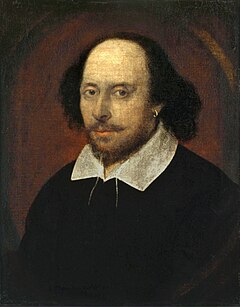
William Shakespeare
           By 1592 William was mixing with the elite of the literary and theatrical worlds. But the role of a playwright was still not viewed as a creditable occupation. It could, in fact , be a very dangerous one as plays could be used as vehicles for propaganda. The State understood the power of plays. Therefore, all plays that were to be printed had to be registered, which ensured a form of censorship. Shakespeare never published any of his plays during his lifetime.In 1596 the Shakespeare family continued to prosper. But the good fortune came to an untimely and abrupt end when, in August, their son Hamnet died at the age of just eleven years. There is no documentation which records the cause of Hamnet's death but it is highly likely that he died of the plague, which had wreaked so much devastation in London 6 months before. Hamnet was buried in Stratford. 
        In 1610, with his fortune made and his reputation as the leading English dramatist unchallenged, Shakespeare appears to have retired to Stratford.  Anne had her husband home at last. His business interests took him to back to London on occasion but the majority of his time is spent at home. He would have been able to enjoy life with his family including his daughters and granddaughter, Elizabeth.
          Shakespeare did, however, draft his will in January of 1616. Perhaps he was unwell. There are no records or documented evidence which throws any light as to the health of Shakespeare in 1616. The strain of the scandal surrounding Judith would not have helped. William’s son-in-law, Dr. John Hall, oversees his final days and treatment. And in April 1616 William Shakespeare dies. (The exact date or cause of death is unknown but it seems fitting that he died on April 23rd April, the same approximate date of his birth, on St. George's Day, the patron Saint of England). The funeral of William Shakespeare was on April 25th 1616  when he was buried in the chancel of Holy Trinity Church in Stratford. Anne, of course, would have been the chief mourner supported by the family of William Shakespeare.The only mention that Shakespeare specifically makes of his wife was to leave her his "second best bed." This is probably the most famous entry of any last will and testament. To bequeath such an item sounds totally ungenerous. It is, however, understood that it would have been Anne's right, through English Common Law, to one-third of William's estate as well as residence for life at New Place. So one of the most famous slap-on-the-face postmortem gifts, could actually not be that at all, and instead be a symbol of the love Anne and William Shakespeare shared.

Sunday, October 30, 2011

Finding Ithaca

Springs once used to water pigs
All through reading Homer's The Odyssey, a reccuring theme is Odysseus's longing to return home. Odysseus had went to fight in the Trojan War, a war that lasted ten years. Odysseus spent an additional ten years trying to return to his island kingdom of Ithaca. Homer wrote:


Around her [Ithaca] a ring of islands circle side-by-side,
Doulichion, Same, wooded Zachynthos too, but mine
lies low and away, the farthest out to sea,
rearing into the western dusk
while the others face the east and breaking day


But was Ithaca a real island, or just the creation of a master storyteller at work?


The narrow isthmus connecting the
 mainland and peninsula
This question not only haunted me but also, thankfully, amateur archaeologist Robert Bittlestone. Bittlestone believes that a peninsula on the island of Cephalonia was once a separate island, Ithaca.He believes that the low-lying isthmus that connects the main island and the peninsula was once not land, but the sea. When a team of geologists dug as far as possible without hitting bedrock they decided, the peninsula, called Paliki, had once been its own island. "I am convinced," said Bittlestone, "that in Ithaca, Homer describes a real place, and I think he talked about locales that people knew and could recognize. His audience say, 'Oh, yeah, I know that cave, that mountain, that bay.'" You can trace the steps Odysseus could have made upon his return home and match all of Homer's descriptions. The mouth of a harbor clearly matches the description of Phorcys Bay, where Odysseus was returned home, "with two jutting headlands sheared off at the seaward side. You can also still see a pig farm matching the location and time period Homer gives as Eumaeus', the swineherd. Up on a 830-foot-high cliff called Kastelli, lie the remains of a once grand palace. Could this be the place where Penelope waited twenty years for Odysseus? More than likely, yes.

Friday, October 14, 2011

The Night Sky: A Journey from Dachau to Denver and Back


     Ask any bestselling author what the most important marketing tool is for selling a book and they’ll exuberantly proclaim BLOGGERS!   That’s why I was thrilled when Katie Sue invited me to do a comment on her blog for The Night Sky:  A Journey from Dachau to Denver and Back.  Awesome bloggers like Katie Sue can do amazing things for first-time authors like me.


    The Night sky is my first book and I wrote it because many people told me it was an extraordinary and inspiring story that could encourage other people to pursue their hopes and dreams.  The overall message in this book is about never giving up, and seeking so you can find.  The story has a little something for enthusiasts in all genres:  History, Genealogy, Mystery, WWII, Germany, Poland, and Ukraine -- but for me, it’s a tragic love story.  I wrote the book from a special place in my heart, and I wanted readers to see, hear, smell, touch, taste, and, most importantly feel what I saw, heard, touched, tasted and felt.   One of my reviewers wrote that sometimes the honesty in the book was almost too painful to bear.  I will admit I cried when I wrote some of the sections in the book, but I knew it was my story, and it may not evoke that same emotion in readers who don’t know me.  It has been gratifying to find that readers have shared my pain and my joys – and that’s the best validation for which any writer could hope.


    Thank you, Katie Sue for giving me the opportunity to comment on your Blog.  The full product description can be found by searching for “Maria Sutton” on Amazon.com, or:


http://www.amazon.com/s/ref=nb_sb_noss?url=search-alias%3Daps&field-keywords=maria+sutton


-Maria Sutton, author of The Night Sky:  A Journey from Dachau to Denver and Back

Wednesday, September 28, 2011

Dante and Beatrice- A "Comedic" Romance

          Dante Alighieri was perhaps one of the greatest poets of the Medieval Era. But, before last week all I thought about him was he wrote a freaky book named Inferno. What I failed to realize, however, was Dante a hopeless romantic. Dante was only eight years old when he laid
The famous greeting
(Dante and Beatrice by Henry Holiday)
eyes on Beatrice Portinari, the daughter of a wealthy banker. How many eight year-old boys would notice what a girl wore, let alone remember it for the rest of his life! He wrote she wore a dress of soft crimson  and a belt about her waist. He noted her noble qualities and angelicness. He also stayed at places where he could often catch a glimpse of her. The first time they spoke was when they were 18 and she greeted him while passing him on the street. Her mere greeting caused him to flee to the solitude of his own room where he fell asleep and dreamed what would become the first sonnet in his La Vita Nouva, one of the greatest love poems of all time. In 13th century Florence, arranged marriages were quite normal. So at the age of 21, Dante was married to Gemma Donati, to whom he had been betrothed since the age of 12. Sadly, Beatrice was married later that year, only to die three years after that at the age of 24. Dante was devastated. Beatrice remained his muse for the rest of his life. In the last book of the Divine Comedy Paradise, it is Beatrice who escorts him into Paradise.


Monday, September 26, 2011

O, Juliet by Robin Maxwell

    Everyone knows the story of the star-cross'd lovers from Verona. In this novelization the equally doomed lovers hail from Florence, are quite older, eighteen and twenty-five, and Dante Alighieri biggest 15th century fans. When Romeo Monticecco attends a Medici ball in order to gain a peace-making audience with the the city's patron, Cosimo de'Medici. At this ball Romeo meets Juliet Cappelleti, the daughter of the man his father hates. Juliet is the daughter of wealthy silk merchant, Capello Cappeletti. Capello wanting to further his wealth and prominence seeks a partnership with Jacopo Strozzi, whose family's wealth and power is second only to the Medici. In order to cement this partnership he offers his daughters hand in marriage to sweeten the deal. Jacopo, however, is no Prince Charming. He stinks, is cruel, and will do whatever it takes to get the handsome, verse-writing Romeo out of Juliet's head. There isn't a nurse in this retelling, but Lucrezia Tournabuoni de'Medici serves as Juliet's confidante and best friend.
      This retelling make the come to life in a new way. Shakespeare's version is still yet to be eclipsed , but this way way easier to understand. I hate to give any part of this book away to spoilers but the way Juliet's cousin, Marco, not Tybalt, gets murdered creates for far better drama. I would really recommend this book. But one thing that hasn't changed is there was never a tell of more woe than that of Juliet and her Romeo.

Saturday, September 10, 2011

What to wear to your execution?

     I know this is a macabre subject, but it has always intrigued me. What did royals choose to wear before they lost their heads?
Think about it. You are most likely going to be buried in it and it will be your last public viewing. How do you decide which outfit to wear for such a momentous historical occasion? I think the last choice of clothing says a lot about how royals chose to be remembered.


King Charles I
Charles decided to dress warm for the occasion and broke out two heavy shirts. He was worried that he would shiver in the cold and consequently look fearful. Charles had always been viewed as the weakling in the shadow of his stronger, older brother, Henry so even at his death he was concerned about appearing brave.Charles I strikes me as the kind of ruler who focuses on the details instead of seeing the big picture. At his death, he is worried more about his hair than the head he is about to lose.

Queen Anne Boleyn
                                                                                                                                          
Queen Anne
Anne traded in her square plunging necklines and went to her execution with a conservative make-over. She chose to wear a loose dark, gray gown of damask trimmed in fur with a matronly mantle of ermine covering her regal shoulders. More interestingly, she adorned her soon-to-be-missing head with the simple, gabled head-dress which was frequently worn by her demure predecessor Jane Seymour. This hairstyle choice is an obvious contradiction to her signature, and far more risque French hood which all her attendants had once copied. With one swipe of the executioner’s sword…French hoods were out and making your head look like a church steeple was back in vogue.

Mary Queen of Scots
Mary chose a crimson petticoat – a clear symbol of a catholic martyr. When Mary was convicted of plotting Queen Elizabeth's assassination, she knew her death would bring outcries from Catholic nations such as Spain and France. By her simple choice of clothing, Mary shifted the cause of her downfall from treason to religious persecution. Although religion was undeniably a huge factor in her death, that blazing red petticoat was one last stir of the pot from a tragic queen.After her death, Mary’s red petticoat was burned for the fear that it would become another saint’s relic

Queen Marie Antoinette
Marie didn’t get much say in the matter. She was even forbidden to wear the tattered and torn, black mourning dress she had been wearing for two months straight, most likely because the revolutionaries did not want any public sympathy for her. Instead, Marie climbed into an old, rubbish cart wearing a clean, white chemise that she had saved for the occasion and a fichu (large, squarish kerchief) over her shoulders. A pleated white cap adorned her famed, strawberry-blond, hair which had been cropped at the neck.
Not as glamorus as you'd think, right?


Tuesday, September 6, 2011

Becoming Marie Antoinette

    Becoming Marie Antoinette is a novel that was released this August by Juliet Grey. It is the first part of a planned trilogy and the book features an excerpt of the sequel Days of Splendor, Days of Sorrow. The first book follows Marie from when she is ten until she becomes Queen of France at 18. To me this books feels a little long at 400 pages, but it is great with the little details that make the French and Austrian courts come alive. Filled with smart history, treacherous rivalries, lavish clothes, and sparkling jewels, Becoming Marie Antoinette will utterly captivate fiction and history lovers alike.

Tuesday, June 21, 2011

Montagues and Capulets: Fact or Fiction?

The opening lines of Shakespeare's Romeo and Juliet tell of two warring families, the Capulet's and Montague's, also telling the tragic out come of " two star-cross'd lovers" right from the start.


 Two households, both alike in dignity,
In fair Verona, where we lay our scene,
From ancient grudge break to new mutiny,
Where civil blood makes civil hands unclean.
From forth the fatal loins of these two foes
A pair of star-cross'd lovers take their life;
Whole misadventured piteous overthrows
Do with their death bury their parents' strife.
The fearful passage of their death-mark'd love,
And the continuance of their parents' rage,
Which, but their children's end, nought could remove,
Is now the two hours' traffic of our stage;
The which if you with patient ears attend,
What here shall miss, our toil shall strive to mend.
       
 .


But the question on my mind after reading this was who were these two families?


A HISTORICAL EXPLANATION


Shakespeare based his most popular tragedy, Romeo and Juliet, on two very real people. These young lovers lived in Verona, Italy ,just like his characters, and died in a real-life tragic love story in 1303. The Capulet and Montague families were prominent citizens of Verona at the time.Apparently, Shakespeare uncovered their story in literature. A poem, "The Tragical Historye of Romeus and Juliet," by Arthur Brooke, was written in 1562. William Painter, a prosist, penned "The Goodly History of the True and Constant Love of Rhomeo and Julietta. Matteo Bandello had written a novella of the story in 1554, revising Luigi da Porto's "Guiliette e Romeo" ("Juliet and Romeo"). Even earlier, Masuccio Salernitano had recounted the story of the tragic young lovers in "Mariotto and Gianozza of Siena" (which doesn't sound nearly as catch-y) in 1476.Italian traveling theater companies performed the drama throughout Europe and England. So, in all actuality Romeo and Juliet is not the original work of William Shakespeare but  just a tale retold from history.
Juliet's Balcony in Verona, Italy. Those are hundreds of love letters under it.

Tuesday, June 14, 2011

Reading Cleopatra Confesses

         I love books written by author, Carolyn Meyer. So naturally when I heard she was writing a Cleopatra book I flipped. Cleopatra is one of my favorite women in history. She was smart, beautiful, and two of the most powerful men in the world loved her. I am currently on page 181 out of 283 and so far I really like this book. There isn't really a whole lot of dialogue so you feel like you know Cleopatra on an intimate BFF level, and I like that. If you like ancient Egypt chances are you will like this book. Not a hard read and definitely a good book!


LinkWithin

Related Posts Plugin for WordPress, Blogger...